March 27, 2016

Woodcock Sky Dance

Background


The American Woodcock has got to be Mother Nature's most ridiculous concoction. With its oddly-placed eyes and grotesquely long bill, its appearance alone nominates it as candidate for goofiest-looking creature alive.

Source: Wikimedia Commons
When it walks, it bounces its body back and forth in a most comical way:

 
Source: YouTube

As if that weren't enough, during its mating display it makes a strange "peent" sound, like a high-pitched game show buzzer, as captured nicely in this Lang Elliott video:

 
Source: YouTube

The "peent" is the prolog of an elaborate mating display called a "sky dance", where the bird flutters its way up high into the sky, making a continuous twitter as it ascends; the twitter eventually sputters to a peak, after which it drops erratically like a leaf, making an odd "chowp" sound as it descends, to land at its starting point. This sky dance is performed at dusk, usually when it's too dark to be seen. But with an infrared camera, we get to see what this sky-dance looks like.

The Skydance Infrared Video

And so, without further ado, here's a thermal infrared video of a full woodcock sky dance. Listen for a soft "gulp" preceding each "peent".


In this next video, I positioned myself closer to the woodcock's stage, and was pleased when the bird landed about 30 feet away. The "gulp" preceding each "peent" is louder and more nuanced, reminiscent of a dove's cooing. What happened next was a total surprise...


The videos were taken with a Therm-App HZ using the ThermAppPlus app, on a Nexus 7 tablet. Audio is from the Nexus 7's built-in microphone, with the volume normalized to the loudest peent. The first video uses a 19mm lens, the second a 35mm lens, which had to be manually refocused when the bird got too close to me.

The original MP4 files as recorded by ThermAppPlus are available at http://pages.cs.wisc.edu/~suan/infrared/info.html.

And Now For Some Fun

Here are a couple of fun YouTube woodcock remixes.


Source: YouTube


Source: YouTube
February 24, 2016

Squirrel and Owl

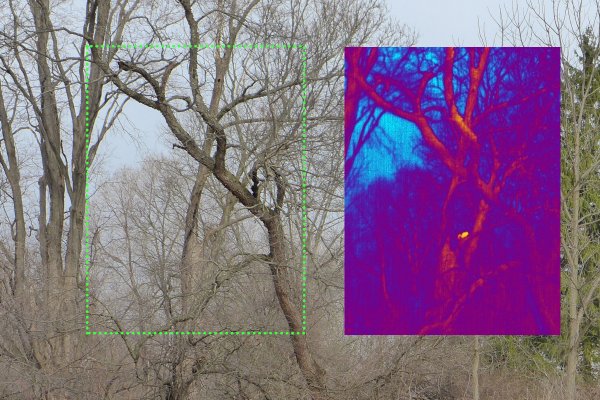
On this pleasant winter morning, I took a stroll through the woods of Six-Mile Creek with my Therm-App. The sky was cloudy, but occasionally thinned out enough for the sun to project some warmth onto the scenery. Nonetheless, warm mammals continued to stand out in the infrared image, such as in this scene:


The bright spot is this squirrel, which even in this close-up photo blends pretty well with the surrounding bark:


I soon entered a thick grove of spruce trees, at which point I could hear some mobbing calls first from some blue jays, then from some crows flying in to complain vehemently before taking off. Once the commotion had passed, I made my way to a better vantage, where I found this:


It was a pretty distinct shape, of a great horned owl:


Zoomed in for maximal impact:


I tried clumsily to make my way into a clearing for better shots, but the cacophony (or possibly simple boredom) drove the bird to take to the wing and drift silently into the ravine and out of sight.

January 10, 2016

Pipits at the Lakeshore

On this cool winter day, as I was walking along the shore of Cayuga Lake, I flushed several American Pipits, little brown birds whose color blends very well with the shingle beach. These relatively rare visitors from the north flew a short distance up the beach and disappeared amid the rocks, where it was a struggle to locate them with binoculars. One big source of frustration is even knowing whether the birds are there; they could easily have taken off unnoticed.

But they could not hide from my Therm-App. Here's a visual and infrared view of the section of beach where I thought the birds might have landed.


While I'd guessed that there might have been about three birds, the Therm-App showed me that there were, in fact, seven birds foraging on the beach in loose association. With some patience I was able to get this close-up of one of them.


And here's a photo of four birds in the same frame, this after my slow approach encouraged them to gather closer to each other.


The flock eventually took to the sky, during which I was able to confirm a count of seven individuals.

Not far from that beach at Salt Point, I came across a nestbox that was showing some warmth:


A closeup photo shows some fur.


Looks like a squirrel has found itself a nice home for the winter.

November 7, 2015

Owl Prowl

On the evening of November 7, the Cayuga Bird Club led a field trip to look for owls in the greater Ithaca area. The weather had been overcast all day, which meant my IR camera had a chance of finding something other than rocks and tree branches.

One of our stops was a stand of tall evergreens at Dodge Road. Here, the IR camera showed a few warm spots in several trees, but in the darkness it was impossible to tell what they were. The club's  playbacks were able to elicit responses from an Eastern Screech Owl, which was nice. Then I noticed a warm spot near eye level not too far away, and to my surprise, it soon turned its head to reveal the unmistakable facial disk of an owl! Here's a video:


I would guess that this screech owl was about 10-15 yards away, and attempts to visually locate it with flashlights all failed. Soon the bird got bored of us and flew away.

After a brief drizzle, we arrived at Star Stanton Road, where our attempts at locating barred owls (or any owls) failed. Here's the group of birders listening intently:


As a consolation prize, I was able to see a small rodent - a jumping mouse perhaps - foraging in the forest floor:


Finally, we visited John Confer's Hammand Hill Owl Banding Station, where they had just netted a hatch-year female. We were treated to close looks at this beautiful creature:


When it came time to release the owl, it simply sat quietly on a stump, looking around curiously until it was finally prompted to depart by the banding student. Here's an IR video of its farewell.


June 18, 2015

Nesting Season

It's nesting season here in the northern hemisphere, a perfect excuse to experiment with the Therm-App infrared camera (and a new 35mm lens with higher magnification).

First, a red-eyed vireo scrutinizes my shenanigans from its low cup nest.


Here's a warbling vireo nest found by Kevin McGowan:


Unlike the previous nest, this was on a sunny morning, and I wasn't sure how well the nest would register. Turned out to be fairly noticeable, since the leaves of the elm tree were not as warm as, say, the trunk of the tree which appears as warm as the nest. But I suspect I would not have been able to find the nest in this sunny weather if I hadn't known it was there.

Here a baltimore oriole's hanging nest glows with warmth on a foggy morning:


I was told that one of these holes was occupied by a pileated woodpecker. Can you tell which?


I observed a sapsucker actively feeding young in one of these cavities: can you tell which?

The trunk of this tree had already been warmed by the sun this morning, so the heat signal would seem to be lost: it is the middle hole (second from bottom). However, on closer scrutiny, it seems like the region of the trunk just below that hole is a little warmer. Warmth from the nestlings, or just coincidence or noise?

For what it's worth, here's a composite I took of the male sapsucker leaving the cavity:


Finally, while there's really no reason to take a thermal image of these red-tailed hawk fledglings on a cliffside nest, sometimes you don't really need a reason:


June 13, 2015

A Walk in the Woods


Here are some thermal observations from a walk in the Mulholland Wildflower Preserve in early June. First, some ducklings, cute even in infrared.

Mama mallard with a train of ducklings.

Continuing with waterfowl: a pair of common mergansers preening on rocks in the creek.


But take a closer look. In the thermal image (less magnified than the photograph), notice how the mergansers' breasts are cold, colder than the surroundings even! Presumably they have not been out of the water for too long. It's worth noting that because water reflects infrared, it's hard to gauge the temperature of the water from the thermal image.

Further down the trail, an eastern wood-pewee was singing its beautiful plaintive song, quite loudly, in fact, from somewhere above. This is a common scenario for woodland birding: you have this small brown bird sitting still somewhere high in the trees, and you just can't seem to find it. But with a thermal imager...

the warm body pops out from its cooler surroundings. Unfortunately, this only works on overcast days, for as soon as there is any amount of sunlight, the reflected IR from the sun makes many things (tree trunks and branches in particular) appear hot, and warm-blooded animals no longer stand out.

Nearby was this set of cavities in a sycamore tree:

I would like to conclude that the top cavity is occupied while the lower two are probably not, but I have no means to confirm this. I should write a blog post focused on cavities in the near future.

Finally, while walking down this dry creek bed, the high-magnification 35mm lens on my Therm-App showed this clear profile of a resting deer.

The deer was remarkably well camouflaged, such that I could never visually see it in its sitting position as shown in the thermal image, even with my binoculars. The deer did eventually walk away (they have little fear of humans in this area, and are actually quite the nuisance for plant life), and I still can't tell whether the deer is present or not in the visual photograph above.

June 11, 2015

Birds and Bees (and Toads, Oh My)


On Saturday, May 30, 2015, I brought my Therm-App to the Finger Lakes Land Trust's Spring Bird Quest at the Ellis Hollow Nature Preserve. It was a cool overcast day, which I thought would be good for thermographic wildlife detection.

After showing off the novelty of seeing squirrels and chipmunks in the woods, I found a warm spot I could not locate with binoculars, until I realized it was not a large object far away, but a tiny object much closer: it was a bee!


Like everyone else there, I'd assumed that insects were cold blooded and would not be detectable. But walk leader Mark Chao later did some web research and reported that "Various insect species, especially bees, thermoregulate. They do not maintain a high temperature all the time, but can warm themselves up quickly when they need to. A bumblebee can warm up its body from an ambient air temperature of 55 degrees Fahrenheit up to 98.6 degrees Fahrenheit in just six minutes!" Thanks, Mark, for the information.


Further along the trail, we found a large warm area high in a tree: a short protruding limb was registering significantly warmer than the rest of the tree, and I conjectured that it might be hosting a roosting warm-blooded critter. Before long, a yellow-bellied sapsucker flew by and into an unseen cavity in that same limb! I regret not having taking better photos of this encounter, but here's one showing the warm limb in the lower-left corner, and the sapsucker perched in the next tree over:


In the visual photograph, the sapsucker is situated lower than in the thermal image, about midway in the second tree from the right. In the thermal image, the warm limb in the lower left does not look as pronounced, because the presence of the warmer sapsucker in the frame of view has shifted the upper bound of the Therm-App rendering. When the sapsucker was absent, the limb was a more prominent yellow against the darker background.

Shortly after, we found a small frog (or toad) leaping through the leaf litter, and I was curious to see its thermal signature:


Cold-blooded: that's more like it. Actually, I was a little surprised that it appeared that much colder than the surrounding leaf litter, rather than matching the ambient temperature. For what it's worth, here's a photograph of the same frog/toad (different pose).


And here are photos of a larger toad that I encountered later.


Finally, here are the bird quest participants hiking through the woods.


Many thanks to Mark Chao for leading the bird quest, and to the Finger Lakes Land Trust for all their work in conserving the natural areas for all to enjoy. Please check out Mark's blog about the month-long bird quest, of which this walk was only a small part: http://www.fllt.org/spring-bird-quest-blog-by-mark-chao/